Astronomy with gravitational waves
Current status and resources
Up-to-date information on gravitational-wave astronomy and expertise at the Max Planck Institute for Gravitational Physics in Hannover and Potsdam.
Observing run O4
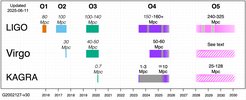
LIGO, Virgo, and KAGRA began their 4th joint observing run on 24 May 2023. O4 will continue until 18 November 2025 at 16:00 UTC. With the detectors’ increased sensitivity O4 will observe a larger fraction of the Universe than previous observing runs. This will result in a higher rate of observed gravitational-wave signals, resulting in a detection of a merger every 2 or 3 days. Additionally, the increased sensitivity will increase the ability to extract more physical information (including unique astrophysical and cosmological information) from the data.
O4a: The first part of the O4 observing run, O4a, began on 24 May 2023 and ended at 16:00 UTC on 16 January 2024.
O4b: O4b began at 15:00 UTC on 10 April 2024 and ended at 17:00 UTC on 28 January 2025.
O4c: This third part of O4 began directly after O4b and is scheduled to continue until 18 November 2025. A commissioning break will took place from 1 April 2025 to 11 June 2025.
More info on the current situation at the individual detectors on https://observing.docs.ligo.org/plan/.

News from the fourth observing run (O4)


Current detector status

Public alerts for signal candidates
During O4 possible transient gravitational-wave signals (candidates for binary merger signals) identified by the LIGO-Virgo-KAGRA Collaboration researchers will be made public in near real time. Data about the candidate, such as the signal type, sky position and estimated distance are published as part of these “alerts”. Professional and amateur astronomers can schedule follow-up observations of gravitational-wave events based on this information.
Public alerts online resources and apps
Public alerts are published on webpages such as GraceDB or Chirp.
During O4, public alerts can be received on Android and iOS with the apps Astro-COLIBRI and Gravitational Wave Events.
Previous observing run: O3 (April 2019 - March 2020)
On 1 April 2019, the twin LIGO instruments, the Virgo detector, and the GEO600 instrument began their third observing run “O3”. KAGRA joined at the end of the run. The detectors’ sensitivities had been further increased in the months before and in previous engineering runs.
In October 2019 after the first half of O3 (called O3a), data taking was interrupted for a full month for maintenance and upgrades at the detectors. The second half of O3 (called O3b) was planned to conclude on 30 April 2020, but was finished already on 27 March 2020 due to the Covid-19 pandemic.
Highlights from O3


Departments and research groups at AEI led by LIGO Scientific Collaboration PIs
LIGO Scientific Collaboration researchers at the Max Planck Institute for Gravitational Physics in Potsdam and Hannover and at the Leibniz Universität Hannover are leading partners in the international gravitational-wave community.
Astrophysical and Cosmological Relativity department

Laser Interferometry and Gravitational Wave Astronomy department

Independent research group Binary Merger Observations and Numerical Relativity

Other relevant departments, research groups, and gravitational-wave experts at AEI
Observational Relativity and Cosmology department
Computational Relativistic Astrophysics department

Permanent independent research group “Continuous Gravitational Waves”
Max Planck Fellow research group “Multi-messenger Astrophysics of Compact Binaries”


